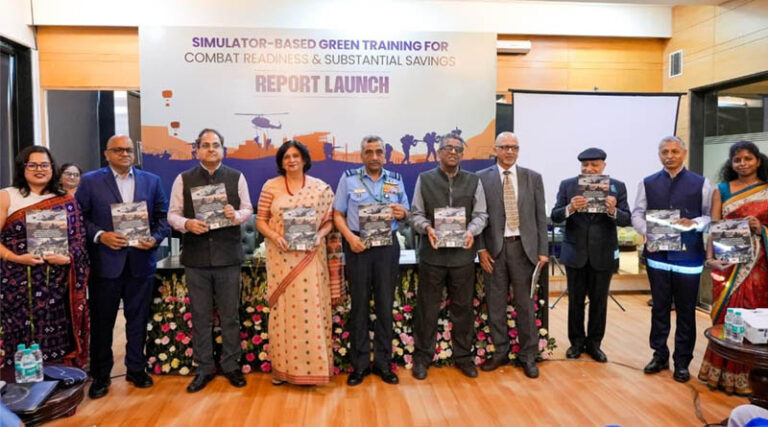
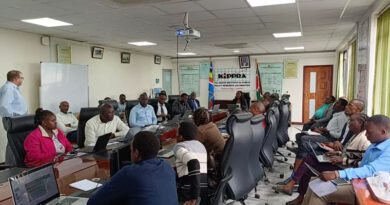
27 May 2026, New Delhi: The Energy and Resources Institute (TERI) today launched its report titled, Indian Armed Forces and Environmental Sustainability: A Comprehensive Assessment of Simulators in ‘Green Training’ at the Constitution Club of India, New Delhi.
The report aims to present a comprehensive assessment of the environmental, operational, and economic benefits of simulator-based military training and highlights its potential in reducing greenhouse gas (GHG) emissions, fossil fuel consumption, ammunition dependency, and equipment wear and tear, while strengthening training outcomes and operational efficiency.
The event brought together senior representatives from the defence establishment, policymakers, think tanks, and industry leaders to deliberate on integrating sustainability into defence preparedness and modernization efforts.
Delivering the keynote address, Dr Vibha Dhawan, Director General, TERI, said, “Energy security is as important as national security, and what TERI conceived years back is proving true today. In case of natural calamities, the armed forces come to our rescue. So, it is also them who bear the brunt of climate change.”
In the special address, Air Marshal Ashutosh Dixit, PVSM, AVSM, VM, VSM, Chief of Integrated Defence Staff (CISC), Headquarters Integrated Defence Staff (HQ IDS), stated, “TERI’s research connects two ideas that matter deeply to us: first, keeping our soldiers battle-ready and second, taking care of the environment. While the armed forces looked at the operational benefits of simulators, TERI thought beyond battlefield and asked a different question–they looked at the environmental and economic outcomes of simulator training.”
Presenting the curtain raiser for the TERI study, Lt Gen V K Saxena, PVSM, AVSM, VSM, PhD (Retd), Distinguished Fellow, CENJOWS and Distinguished Fellow, CLAWS, observed, “Simulator training is not a choice, it is the need of the hour for combat readiness.”
Opening the session, Mr Nitin A Gokhale, Founder, Bharat Shakti, remarked, “Given that the world is in a turmoil today, we should use this uncertainty as a transformational opportunity for changing the nature of training the armed forces.”
The event also featured a roundtable discussion on “Green Training for Armed Forces”, moderated by Mr Nitin A Gokhale.
Panelists included:
Mr Ashok Atluri, Chairman & Managing Director, Zen Technologies Limited
Major General Ashok Kumar Dhingra
Mr Souvik Bhattacharjya, Director, TERI
Speaking during the discussion, Mr Ashok Atluri, Chairman & Managing Director, Zen Technologies Limited said, “The situation has completely changed, we can now visualize any combat scenario using simulator technology. India should set an example and lead the way in simulator integration in the training of armed forces.” Major General Ashok Kumar Dhingra said, “This report is timely; we are all facing the pinch of fuel and the armed forces are the first to take the cut in case of emergency.”
Mr Souvik Bhattacharjya, Director, TERI highlighted, “This study is unique in the sense that it has come up with a unique framework for environmental and economic assessment of ammunitions vis-a-vis simulator technology.”
The discussion focused on accelerating the adoption of simulation technologies across defence systems, strengthening institutional frameworks, and aligning operational readiness with India’s long-term climate and sustainability goals.
The report foregrounds that simulator-based training offers a pragmatic and scalable pathway for balancing national security imperatives with environmental responsibility and economic efficiency. It also highlights the strategic importance of integrating sustainability into defence planning amid increasing climate-related risks affecting military infrastructure, logistics, and preparedness.
The event concluded with a vote of thanks delivered by Mr Souvik Bhattacharjya, Director, TERI.
Global Agriculture is an independent international media platform covering agri-business, policy, technology, and sustainability. For editorial collaborations, thought leadership, and strategic communications, write to pr@global-agriculture.com