Strait of Hormuz Crisis Keeps Global Fertilizer Trade Near Standstill
13 October 2026, Middle East: Fertilizer shipments through the Strait of Hormuz remained close to zero in early September, nearly seven months after military escalation in the region first disrupted passage through the waterway, according to the WTO-AXSMarine Strait of Hormuz Trade Tracker cited by Ukragroconsult on September 14. The prolonged shutdown is keeping sulfur prices above $1,000 a tonne and has pushed phosphate producers in Egypt, Brazil and India to cut output, tightening fertilizer supply heading into major planting seasons in both hemispheres.
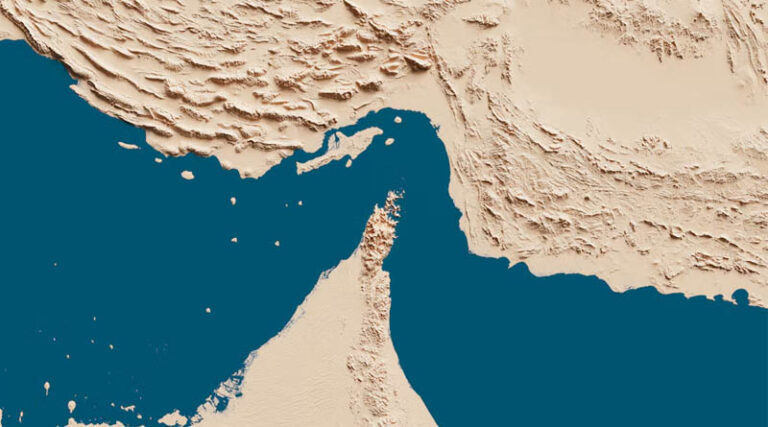
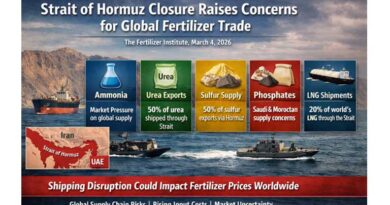
The Strait of Hormuz, the narrow waterway between Iran and Oman through which ships must pass to reach or leave the Persian Gulf, normally carries about a quarter of the world’s seaborne oil trade and, more directly relevant to farmers, roughly a third of globally traded urea, according to an analysis published by the UN Trade and Development body’s International Trade Centre (ITC). Commercial passage through the strait fell sharply after military escalation tied to this year’s Iran conflict in late February, and while a ceasefire has since taken hold, shipping volumes have not recovered to anything close to pre-crisis levels.
The ITC’s analysis of April 2026 trade data, taken near the height of the disruption, found that combined export volumes of twelve key commodities from Hormuz-dependent economies fell 54% from a year earlier. Urea exports specifically fell 83%, ammonia exports fell 75%, and methanol exports fell 80%. Liquefied natural gas exports fell 95%, the steepest decline of any product tracked, while polypropylene exports fell by a comparatively modest 24%. The combined merchandise export value of the affected Gulf economies, which include Bahrain, Iran, Iraq, Kuwait, Qatar, Saudi Arabia and the United Arab Emirates, dropped 21% in April alone.
Importers forced to adapt
On the import side, Japan, which has historically sourced 91% of its crude oil from Hormuz-dependent suppliers, saw those imports fall 64%, with South Korea and Malaysia recording similarly steep declines. Thailand was a notable exception, with imports from the region actually rising as its refiners sourced alternative supplies, illustrating how quickly some buyers found workarounds while others, particularly those more reliant on long-term fertilizer contracts, did not.
By September, Iran and Oman had agreed on coordinates for a designated safe shipping corridor, first announced in August, but Ukragroconsult reported that commercial traffic had not meaningfully recovered even after the agreement, with shipping companies citing insufficient insurance cover and uncertain security guarantees as the reason they remain reluctant to resume regular transits. Cargo that would normally move through Hormuz is instead being rerouted via the Red Sea and Suez Canal or overland pipelines, adding transport costs and transit time that are being passed through to buyers.
Nitrogen and sulfur both squeezed
The disruption cuts across two separate but connected parts of the fertilizer supply chain. Nitrogen fertilizer, chiefly urea and ammonia, is directly affected because the strait historically carried about a fifth of global nitrogen fertilizer trade, most of it originating from large Middle Eastern producers who rely on the region’s cheap natural gas feedstock. Sulfur, a byproduct of oil and gas processing that is also a key feedstock for phosphate fertilizer production, has been squeezed just as hard, and its price above $1,000 a tonne is now feeding through into the cost of making phosphate fertilizers elsewhere in the world.
That knock-on effect is why phosphate producers as geographically distant from the Gulf as Egypt, Brazil and India have all scaled back output this year, citing elevated feedstock costs rather than any direct disruption to their own operations. For India in particular, which imports a significant share of its phosphoric acid and finished phosphate fertilizer requirements, higher global sulfur and feedstock costs translate fairly directly into either higher subsidy outlays for the government or higher retail prices for farmers, depending on how much of the cost increase state-owned and private fertilizer companies are able to absorb.
Global Agriculture is an independent international media platform covering agri-business, policy, technology, and sustainability. For editorial collaborations, thought leadership, and strategic communications, write to pr@global-agriculture.com