CGIAR at AFS Forum 2026: From Evidence To Delivery
Across a packed week in Kigali, CGIAR Centers and Programs showed how African leadership, science, finance and inclusive delivery systems can turn food systems ambition into impact at scale.
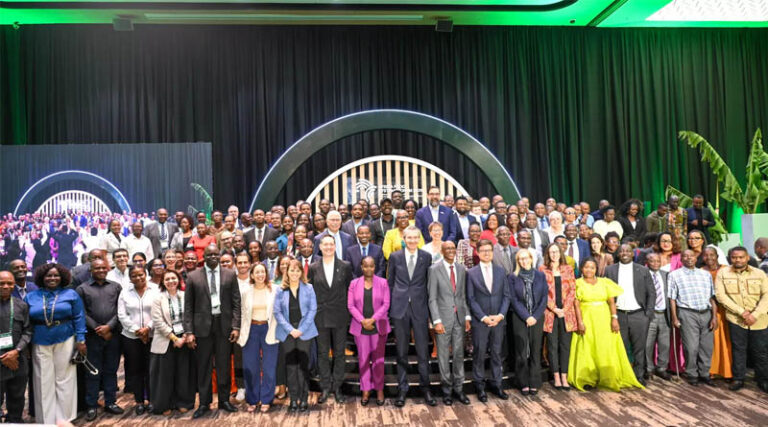
08 September 2026, Africa: Africa does not lack ideas, ingenuity or proven agricultural innovations. The challenge is connecting them to the policies, finance, institutions and markets needed to reach millions of people. That message ran through CGIAR’s engagements at the Africa Food Systems Forum (AFS Forum, or AFSF) 2026 in Kigali, where CGIAR Centers and Programs joined governments, farmers, civil society, development banks, businesses and research partners.
Under the Forum theme, “Investing in Africa’s Agri-Food Systems: Nourishing Nations, Growing Jobs, Building Resilience,” CGIAR brought a clear proposition: investment delivers more when trusted science connects with country priorities and long-term delivery.
CGIAR Policy Innovations helped open the week with “Food Sovereignty in a Fractured World: Africa’s Strategic Agency in Global Food Systems.” In a world of conflict, climate shocks and disrupted food, fuel and fertilizer markets, food sovereignty was framed not as producing everything domestically, but as having the agency to make informed choices. CGIAR Chief Scientist Dr Sandra Milach emphasized that science expands those choices by helping countries assess climate risks, understand policy trade-offs and combine domestic capability with reliable regional trade.
That emphasis on African agency also shaped the CGIAR System Organization’s Strategy 2040 consultation. Partners called for a CGIAR that listens, co-designs and works through strong African institutions—not simply one that supplies technologies. In the Council of the Wise plenary, CGIAR Executive Managing Director Dr Ismahane Elouafi highlighted the “missing middle” between proven research and investment: the partnerships, capabilities and delivery systems that allow innovation to move beyond a project.
The Alliance of Bioversity International and CIAT’s regional launch of its 2026–2030 Strategy translated that systems approach into five connected outcomes: agrobiodiversity; future-proofed farms and landscapes; inclusive food economies; healthy diets; and finance. The Alliance also contributed to sessions on climate adaptation finance, regenerative agriculture, agroecology, climate finance for smallholders and home-grown school feeding.
The diversity of CGIAR’s contribution was evident across the programme. CIMMYT convened “Securing Africa’s Food Future: The Missing Middle.” AfricaRice led “From Seeds to Sovereignty” and, with IFPRI, explored resilience in “Shock to Sovereignty.” CIP and IITA jointly convened “Unlocking Africa’s Roots, Tubers and Bananas Potential.” IRRI, the Alliance and AfricaRice joined forces for “Africa’s NextGen Rice Revolution,” while IRRI also examined school feeding and food loss.
WorldFish’s “Accelerating Africa’s Blue Transformation” connected aquatic foods with nutrition, jobs and resilience. CGIAR Sustainable Farming convened “Next-Gen Agricultural Solutions” and joined IWMI for “El Niño: From Data to Action.” CGIAR Gender Equality and Inclusion advanced discussions on gender research, youth leadership, women in food systems and inclusive digital agriculture. IFPRI and HarvestPlus addressed scaling nutritious, climate-smart food, while IFPRI also brought policy and grassroots investment accountability into the Forum.
Together, they showed the value of connecting genetics, production, natural resources, diets, markets, policy and finance around African priorities.
That connection was at the centre of CGIAR Scaling for Impact and IRRI’s official side event, “Capital, Science, Partners: Connecting Scientific Innovation to Development Finance at Scale.” The Technologies for African Agricultural Transformation (TAAT) programme showed what can happen when research, governments and the private sector work as a “triple helix.” TAAT has reached more than 25 million farmers and influenced billions of dollars in agricultural investment.
Yet speakers warned against equating technology distribution with transformation. “A bag of seed is not economic transformation,” said the African Development Bank’s Dr Martin Fregene. Infrastructure, finance, functioning seed systems, markets, policy and local delivery capacity must move together. IITA Director General Dr Simeon Ehui captured the shift succinctly: “Technology alone does not scale the system; systems scale technology.”
The Pan-Africa Bean Research Alliance’s 30th anniversary offered a powerful proof point. Led by the Alliance, PABRA has linked crop improvement with nutrition, markets, seed systems and policy through more than 900 partners across 31 countries, releasing over 600 bean varieties and reaching more than 40 million farmers.
The International Water Management Institute (IWMI) brought a crucial message: food security cannot be achieved without water security. Its issue brief, “Why water matters for Africa’s food systems: A call to action for irrigation investment,” argued that irrigation enables year-round production, nutrient-dense crops, stronger markets and resilience—but only when investment moves beyond infrastructure.
Across “El Niño: From Data to Action” and the booth’s interactive “Spin the Wheel for Water,” IWMI focused on translating water science into decisions. Reliable irrigation requires suitable finance, sustainable maintenance, accountable institutions, climate information and equitable access—making water foundational to productivity, nutrition and climate adaptation.
The CGIAR booth provided a daily demonstration of how these ideas become usable tools. IWMI, the Alliance and CGIAR Scaling for Impact presented “From Barriers to Business Case: The Enabling Environment Toolbox in Action.” The digital Toolbox diagnoses barriers across policy, finance, institutions, capacity, data and markets, then connects them to evidence, methods and practical investment pathways. It helps partners identify what must change around an innovation and build a credible, fundable intervention.
The booth programme moved across CGIAR’s breadth: IWMI explored water priorities; IFPRI showcased research partnerships and policy; WorldFish presented aquatic-food solutions; CIMMYT exhibited tangible innovations; and the Alliance connected strategy with science in action. CGIAR Policy Innovations demonstrated decision-support tools; IITA and the Seed System Innovation Program took cassava, yam, banana and plantain “From Seed to Scale”; TAAT presented e-catalogues and seed-tracking tools; and Better Diets and Nutrition closed the week with interactive food plates and healthy-diet games.
The booth allowed partners to question and test the tools behind CGIAR’s wider Forum messages.
At the Better Diets and Nutrition Program’s educational lunch, participants compared four plates and examined adequacy, diversity, balance and moderation. Diets are shaped not only by preference, but by availability, affordability, accessibility, time, agency and the wider food environment. If transformation is working, it should be visible on people’s plates.
The African-Led Excellence in Gender Research session called for gender to be embedded from research design through implementation and evaluation. Counting participation is not enough; evidence must show changes in agency, leadership, access to finance and technology, resilience and decision-making. IFPRI’s civil society roundtable extended that principle to investment governance, arguing that farmers, women, young people and grassroots organizations must move beyond consultation to co-design, monitoring and accountability.
The ministerial roundtable hosted by the International Livestock Research Institute (ILRI) and the African Union Inter-African Bureau for Animal Resources (AU-IBAR) on “Scaling What Works in African Livestock Systems” provided another test of delivery. Ministers and representatives from eight countries committed to cooperate on productivity, investment, markets and regional trade. Participants proposed institutionalizing the ministerial platform to support the African Union’s Integrated Regional Livestock Value Chain programme, with priorities including patient finance, harmonized trade standards, shared data and country-to-country learning.
Across Kigali, the common thread was not a single crop, technology or financing mechanism. It was the architecture connecting them: African leadership, sound evidence, inclusive institutions, capable partners, finance aligned with national priorities and sustained support through implementation.
CGIAR’s contribution is strongest when its Centers and Programs work across those connections as a long-term science and technical partner. The task after AFSF is to carry that momentum into country investment plans, regional cooperation and delivery on the Kampala CAADP commitments. Africa already has many of the solutions. The imperative now is to finance, adapt and scale what works—and judge success by better diets, stronger livelihoods, dignified jobs and greater resilience across the continent.
Also Read: Bayer Advances Plan to Launch 10 Blockbuster Products Over the Next 10 Years
Global Agriculture is an independent international media platform covering agri-business, policy, technology, and sustainability. For editorial collaborations, thought leadership, and strategic communications, write to pr@global-agriculture.com