04 September 2026, Iowa: Bayer has begun commercialising products under its plan to bring 10 blockbusters to market over 10 years, with launches spanning seeds, traits and crop protection.
The company defines a blockbuster as a product with expected peak sales potential of at least €500 million. Two products, Plenexos™ insecticide and the Preceon™ Smart Corn System, have already entered commercialisation. Bayer expects to introduce Vyconic™ in the United States and Canada in 2027, while Intacta 5+™ is planned for the 2027/2028 growing season in Brazil.
“We are delivering on the promises we made and bringing a new generation of products to farmers. By connecting seed and crop protection innovation we can deliver whole-farm solutions that help growers manage risk, capture yield potential and improve return on investment,” said Rodrigo Santos, Member of the Board of Management of Bayer AG and Head of the Crop Science Division.
“We pursue a very diligent and differentiated strategy for each of our segments, addressing different growth dynamics, farmer needs, and regional and competitive dynamics. Because we have scale, we see having these different business segments together as a significant strategic advantage, one that plays out in what we innovate and how we can serve growers.”
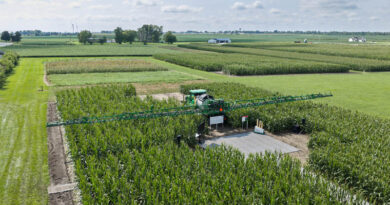
The Preceon™ Smart Corn System, a digitally enabled short-stature corn system, is currently being commercialised in Mexico, Italy, Spain and the United States. Bayer will begin its commercial launch in Argentina this year.
The system is designed to provide greater protection against weather extremes, allow higher planting densities and improve access for standard farm equipment during the season. Bayer is targeting market penetration of 26 million acres by 2035. The system also incorporates FieldView™ digital capabilities for farmers and agronomic advisers.
Plenexos™, an insecticide targeting sucking pests, has been introduced in Colombia, with launches planned in Mexico, Brazil and the United States. Bayer said farmers can use up to 75% less active ingredient compared with other products for pest control, based on more than 600 trials conducted between 2021 and 2025 in Brazil. The product is being developed for use in soy, cotton, fruits and vegetables and has an anticipated peak sales potential of €500 million by the mid-2030s.
Vyconic™ is being developed as a soybean trait stack with tolerance to five herbicides. Bayer said the trait is designed to provide greater weed-control flexibility and support resistance management. Through integration with the company’s breeding pipeline, Vyconic™ will be introduced in soybean varieties that have recorded yield increases of more than two bushels per acre.
Bayer expects Vyconic™ and the subsequent HT5 launch to support its target of regaining trait leadership in North America by 2032.
In Brazil, Intacta 5+™ will provide tolerance to five herbicides along with insect protection traits developed for the Brazilian market. Bayer expects its soybean trait portfolio, together with next-generation herbicide tolerance and insect protection traits, to generate peak sales potential of more than €3 billion.
Other blockbusters planned before the end of the decade include fourth-generation corn rootworm protection and the herbicide Icafolin, which has a targeted sales potential of €750 million in the mid-2030s.
Crop Science R&D pipeline
Bayer said it continues to develop products across its Crop Science R&D pipeline, with 400 to 500 new hybrids and varieties introduced annually.
The company’s AI-enabled precision breeding platform is designed to increase the rate of genetic gain compared with historical breeding and reduce time to market. Bayer is also using genome editing earlier in its breeding programmes.
One development is genome-edited soybean with improved plant architecture. Bayer said taller, higher-yielding soybean varieties can be more susceptible to leaning or lodging, and the new approach is intended to address this issue. Products based on the technology are expected to reach the market early in the next decade.
Bayer is also developing its sixth-generation herbicide tolerance technology alongside Icafolin. The company said this is the first time it is developing a new herbicide molecule and a plant trait for tolerance at the same time, with the aim of creating an integrated weed-control system.
In crop protection, Bayer’s AI-powered CropKey platform is being used to identify new modes of action and develop molecules by assessing efficacy, safety and sustainability during the R&D process.
The company currently has more than 15 novel modes of action in the research phase. One of the projects is a broad-spectrum fungicide for soybean with blockbuster potential, which has advanced to Phase II development.
“Whether in seeds, traits or crop protection innovation, AI is becoming a core enabler of Bayer’s innovation model, helping us advance discovery, improve development efficiency and translate biological insights into differentiated products for growers faster,” said Mike Graham, Head of Crop Science R&D.
“Our advantage is that our teams work from the same biological insights, enabling us to combine expertise across disciplines and accelerate innovation.”
Bayer is also developing crops for biofuel markets, including camelina, winter oilseed rape and CoverCress™. The company is also planning to introduce hybrid wheat in Europe and North America by the early 2030s.
Five-Year Framework
Bayer said implementation of its Five-Year Framework, announced by Crop Science in 2025, remains on track.
The company has reduced costs by almost €400 million to date and is targeting a €1 billion improvement in EBITDA before special items. It also aims to achieve an EBITDA margin before special items in the mid-20% range by the end of the decade.
Bayer has discontinued more than 100 crop protection formulations and divested five active ingredients. Inventory reductions of €500 million are also part of the company’s cash-flow measures, with a target of more than €3 billion in free operating cash flow by 2029.
The Five-Year Framework targets above-market growth and more than €3.5 billion in incremental sales at constant currency through the end of the decade. Bayer said growth is expected to come from new hybrids, technology adoption, market share gains and geographic expansion, including in Asian and EMEA markets.
In crop protection, the company is focusing on local go-to-market initiatives, reallocating commercial resources towards growth products and regions, and lifecycle management of existing products.
“Our innovation strategy and our Five-Year Framework are built on execution,” said Santos. “We are making progress against the commitments we have made, and are set to lead the industry and bring value to our customers and shareholders by delivering differentiating solutions that growers around the world need.”
Global Agriculture is an independent international media platform covering agri-business, policy, technology, and sustainability. For editorial collaborations, thought leadership, and strategic communications, write to pr@global-agriculture.com