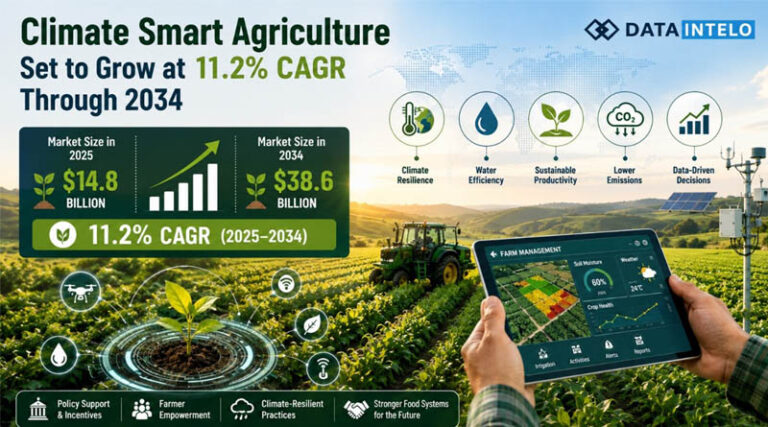
Climate Smart Agriculture Set to Grow at 11.2% CAGR Through 2034
Guest Author: Ashish Kolte, DataIntelo
11 August 2026, New Delhi: Climate-resilient agricultural technology investments are transitioning from experimental efforts to fundamental infrastructure as policymakers, agribusinesses, and financiers reach one common understanding: resilience is a necessary aspect of future global food systems.
Climate Smart Agriculture (CSA) is expected to go through an important phase of development over the next decade. According to the most recent research report by Dataintelo, the global market was estimated to be worth $14.8 billion in 2025 but will reach about $38.6 billion in 2034, recording a 11.2% CAGR over the period.
This growth projection mirrors the current state of affairs that the UN Food and Agriculture Organization describes: agrifood systems account for 32% of all GHG emissions globally as of 2023 and sustain over 1.2 billion livelihoods while receiving inadequate funding from climate finance sources. For decision-makers, the market’s growth curve reflects capital finally catching up to a sector whose climate exposure has long outpaced the resources directed at it.
Recent Developments
Several examples show the rapid movement in the landscape. At the start of 2026, Deere & Company increased its projected net income for the year by up to $4.5 to 5.0 billion, with the increase largely attributed to the ever-growing relationship between Bayer’s Climate FieldView platform and Deere’s Operation Center that allows the use of data prescription without the need for manual file transfer between the two systems. Moreover, Deere expanded its use of AI-enabled camera spraying system acquired through the acquisition of Blue River Technology into new frontiers, with cooperatives in Kenya and Nigeria piloting the system on cassava and maize, and experiencing fewer passes with pesticides per season while maintaining harvest weight.
The Digital Agriculture Mission, which is being funded at ₹2,817 crore (~$335 million), is creating AgriStack, an identity database of farmers in India that aims to be on par with the payments system of India known as Unified Payments Interface (UPI). Till early 2026, around 86 million of the 110 million IDs had been issued to farmers, while the 2026 Union Budget saw the launch of Bharat-VISTAAR, an AI platform for AgriStack in multiple languages.
In Europe, OECD monitoring of the EU’s Common Agricultural Policy found eco-scheme uptake highly uneven by design: most individual schemes reached only 12–65% of planned area, while the pesticide-reduction scheme was so oversubscribed it hit roughly 460% of target. In Spain’s 2026 CAP campaign, 82% of the more than 560,000 farmers applying for income support also applied for at least one eco-scheme — evidence that farmers respond strongly to incentives with clear input-cost payback, and more cautiously to ones requiring bigger operational change.
The Investment Paradox
The most important dynamic for decision-makers to understand may be this: agtech venture funding has contracted sharply even as market-size forecasts climb. AgFunder’s 2026 Global AgriFoodTech Investment Report found overall funding flat at $16.2 billion, with deal count down 12%. PitchBook recorded just 263 agtech deals in H1 2026 worth $2.4 billion — a pace that, if it continued, would mean a roughly 40% decline in deal volume from 2025’s already-reduced total of 875 deals. Analysts characterized 2026 as the likely bottom of the cycle, with no rebound expected before 2027.
This isn’t declining investor conviction in CSA — it’s a change in what type of capital is funding the sector’s growth. Investors have shifted toward later-stage, revenue-generating companies over growth-at-all-costs bets reminiscent of 2021, when agriculture startups raised $10.5 billion across 1,419 deals. Exits now run almost entirely through strategic acquisition (Deere’s 2025 purchase of driverless-sprayer maker Guss Automation is one example) rather than IPOs. The practical implication: market growth ahead is more likely driven by corporate capital expenditure, government programs, and M&A consolidation than a new wave of venture-funded disruption — a materially different growth pattern than the one that built the sector’s first generation of tools.
Market Outlook by Region
Asia Pacific holds the largest CSA market share and is forecast to grow fastest, driven by farmland scale across China, India, Indonesia, and Vietnam and high exposure to monsoon disruption and drought. India’s AgriStack build-out is a large-scale demand generator in its own right. North America remains second-largest, underpinned by farm consolidation and continued investment in integrated farm-management software, reflected in Deere’s raised guidance.
In Europe, development happens through regulations: with around 90% of European Union farmland covered by mandatory environmental conditionality and 25% of direct payments linked to voluntary eco-schemes, the baseline level of verification and sustainable practices is higher than anywhere else. The Middle East, Africa, and Latin America are developing the fastest, driven by requirements from their export chains and the availability of next-generation agricultural technologies like AI-directed spraying, which leapfrogged the GPS-only technology prevalent in other regions.
Segment Insights
However, hardware solutions such as GPS-enabled equipment, sensors, drones, and irrigation controls still represent the largest portion of the CSA budget, although software and services solutions are gaining momentum, supported by decisions such as Deere and Bayer’s cooperation. The use of precision agriculture is prevalent; however, livestock monitoring and aquaculture are also becoming important due to the reduction of methane emissions. AI and machine learning are the fastest-growing technology layer, shifting — as one 2026 industry analysis put it — from predictive tools toward agentic systems that close the loop between digital insight and autonomous field action, such as spraying systems that decide and execute treatment in real time.
Case Studies
Iowa Soybean Association, US. Under USDA’s Partnerships for Climate-Smart Commodities program, the association’s Midwest program has grown to more than 1,800 enrolled farms tracking cover-crop and grazing-management outcomes — notable because it has kept expanding even as the federal program itself sits under formal review since May 2025.
World Bank agriculture portfolio, global. As of FY2024, the World Bank agriculture and food portfolio projects have assisted 4.7 million farmers utilizing improved technologies, while climate finance accounts for 62% of all agriculture-sector lending, an increase from 51% compared to the previous year. The FY2022-24 approved projects will prevent 174.5 million tons of CO2 equivalent emissions.
Climate Smart Agriculture and Water Management Project in Bangladesh. A US$120 million World Bank project focusing on about 170,000 climate vulnerable households improved flood and irrigation management on 120,000 hectares of land with an objective of reducing crop losses from floods by 60%.
Locally led adaptation, Belize and Kenya. Not all effective CSA is technology-intensive. The Mayan people of Belize have been practicing Inga tree alley farming to restore soil fertility without deforestation; the feed innovation in Kenya has enabled more than 1,500 families to practice climate-resilient feeding of goats using locally available herbs and save costs. The low-cost practices are hardly considered in measuring the markets for CSA because the market for CSA is largely based on the capital-intensive approach.
Adoption Barriers
A 2026 systematic review of 58 empirical studies across Sub-Saharan Africa and South Asia found CSA adoption shaped less by technology availability than by household factors — education, land tenure security, credit access, and extension contact. The review also flags an evidence gap: negative effects, including cases where CSA increased labor burdens or displaced food crops with cash crops, are documented far less often than positive outcomes.
Separate field research in Mozambique found farmer awareness of CSA practices strongly bimodal — a meaningful share highly informed, another substantial share almost entirely unreached — suggesting extension infrastructure, not technology cost, remains the binding constraint in many geographies. That finding lines up with FAO’s assessment that agrifood systems remain underfunded in national climate plans generally. For companies and governments building CSA strategy, distribution and farmer education matter as much as the underlying technology.
Outlook
The headline growth number 11.2% CAGR to roughly $38.6 billion by 2034 is real and well-supported by regional policy commitments, corporate capital expenditure, and institutional lending data. But the capital structure funding that growth has shifted: early-stage venture funding has pulled back toward proven, later-stage technology; government programs face political uncertainty even as new ones like India’s AgriStack scale rapidly; and regulatory incentive design — as the EU’s uneven eco-scheme uptake shows — determines adoption speed as much as technology maturity does. Decision-makers who track which capital sources and incentives are actually moving farmer behavior in their specific geography will be best positioned to capture the sector’s benefits through 2034.
Also Read: Novonesis To Acquire Remaining Share Of Microbiogen To Strengthen Yeast Capabilities
Global Agriculture is an independent international media platform covering agri-business, policy, technology, and sustainability. For editorial collaborations, thought leadership, and strategic communications, write to pr@global-agriculture.com