New Diagnostic Test Detects Only Living, Disease-Causing Bacteria in Crops
18 September 2026, Pennsylvania, USA: Researchers at Pennsylvania State University have developed a laboratory test that can tell whether bacteria found in a plant sample are alive and capable of causing disease, closing a gap that has long affected plant pathogen diagnostics. The method, called the enzyme-linked chaperone assay, or ELCA, is described in a paper by lead author Rachel Herschlag, a doctoral researcher in plant pathology, and co-author Carolee Bull, professor of bacterial systematics and plant pathology, set for the November 2026 issue of the Journal of Microbiological Methods and posted online September 15, 2026.
The problem ELCA is designed to fix is a common weakness in existing tests. The traditional method, called ELISA, uses antibodies raised in animals to detect a target bacterium, while newer DNA-based tests detect genetic material through methods such as PCR. Neither approach reliably distinguishes bacteria that are alive and actively infecting a plant from bacteria that are dead or from leftover genetic fragments in the sample. That distinction matters in practice, because a positive DNA test on dead cell debris can trigger unnecessary destruction of planting material or an unwarranted spray program, while growers and diagnostic labs need to know whether a live, spreading infection is actually present.
How the test works
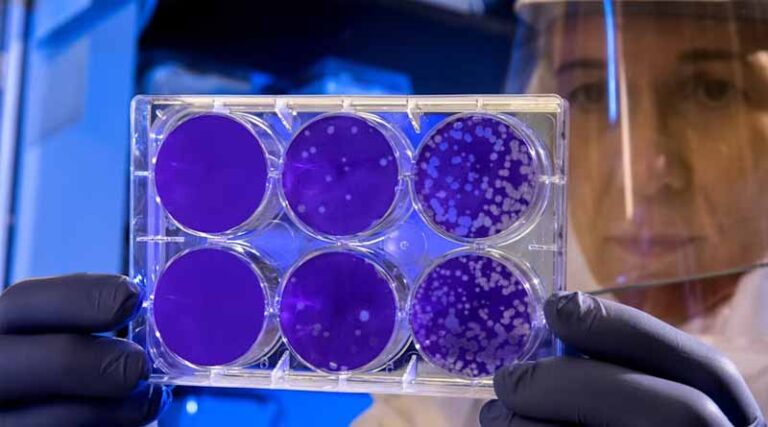
ELCA takes a different approach by exploiting the bacteria’s own infection machinery rather than an outside antibody. Disease-causing bacteria inject specialized proteins called effectors into host plant cells to suppress the plant’s natural defenses and enable infection. Before an effector is deployed, it is protected inside the bacterium by a helper protein called a chaperone, which binds to its matching effector with high specificity. ELCA uses this natural chaperone-effector pairing as its detection mechanism: when the assay’s chaperone binds its matching effector in a sample, the reaction turns a colorless test solution yellow, giving a simple visual readout. Because effector proteins are thought to degrade quickly once a bacterium dies, only samples containing living, infection-capable bacteria produce a strong color change, which sidesteps the false positives that come from DNA-based kits picking up remnants of non-viable cells.
The team tested the approach on Pseudomonas syringae, one of agriculture’s most economically significant bacterial pathogens because of how many crops it affects. Different strains of the bacterium cause bacterial speck on tomato, canker on kiwifruit, and disease in numerous other vegetable, fruit and ornamental woody crops, making a fast, reliable live-or-dead test broadly useful across horticulture rather than for one crop alone. The research was funded through the USDA’s National Institute of Food and Agriculture and its Specialty Crop Research Initiative.
Herschlag and Bull’s team says the next step is adapting the chaperone-effector detection principle to other bacterial pathogens that use comparable protein-delivery systems, an approach with potential relevance beyond crop agriculture, including in veterinary and human bacterial diagnostics that face the same live-versus-dead detection problem. For now, the immediate commercial promise is a diagnostic that is simpler and potentially cheaper to run than PCR, since a colorimetric assay does not require the specialized thermal cycling equipment PCR testing does, making it a plausible fit for extension and certification labs that need quick field-relevant answers rather than genomic detail.
Also Read: CropLife India Flags Narrowing Crop Protection Options for Farmers
Global Agriculture is an independent international media platform covering agri-business, policy, technology, and sustainability. For editorial collaborations, thought leadership, and strategic communications, write to pr@global-agriculture.com