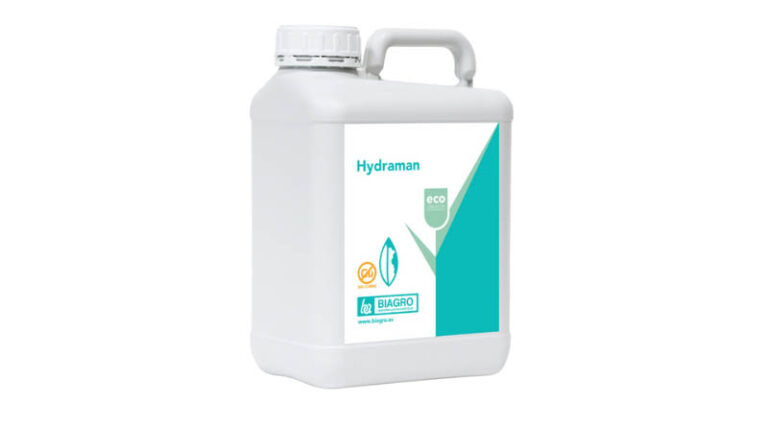
03 August 2026, Valencia: Zinc and manganese represent one of the most commonly paired micronutrient deficiency patterns encountered in commercial crop production, both elements sharing vulnerability to the same underlying soil conditions that limit their availability — high pH, calcareous soil chemistry, and, in some cases, excessive phosphorus fertilization that can antagonize uptake of both elements simultaneously. Hydraman was formulated specifically to address this common co-occurrence, delivering a liquid corrector blend designed to resolve simultaneous zinc and manganese shortfalls in a single, coordinated application.
Zinc’s physiological importance centers on its role as an essential cofactor in auxin synthesis, the hormone responsible for regulating cell elongation and, consequently, shoot architecture and internode spacing. Zinc-deficient crops commonly display the recognizable “rosetting” pattern of shortened internodes and clustered leaf growth at shoot tips, a direct consequence of disrupted hormone-driven cell elongation. Zinc also plays supporting roles in various reproductive-stage enzymatic processes, meaning deficiency can compromise fruit set consistency and eventual fruit size alongside the more visually obvious vegetative growth symptoms.
Manganese, meanwhile, is essential to the water-splitting complex within photosystem II — a foundational component of the photosynthetic electron transport chain responsible for extracting electrons from water molecules during the light-dependent reactions of photosynthesis. Manganese deficiency directly compromises this core photosynthetic function, typically manifesting as interveinal chlorosis and generally reduced vigor stemming from diminished photosynthetic energy production. Because photosynthesis underlies essentially all subsequent plant growth and development, manganese deficiency’s impact tends to be broadly felt across overall plant performance rather than confined to a single specific developmental process.
The practical value of addressing these two elements together, as Hydraman is formulated to do, reflects the reality that many growers encountering one of these deficiencies in the field are likely dealing with the other simultaneously, given their shared vulnerability to common soil conditions. Correcting zinc alone while leaving an accompanying manganese shortfall unaddressed would resolve the visible auxin-related growth symptoms while leaving the underlying photosynthetic limitation from manganese deficiency still constraining overall plant performance in the background — meaning a comprehensive correction approach addressing both elements together tends to deliver more complete performance recovery than treating either deficiency in isolation.
Given the distinct physiological roles these two elements play — zinc’s connection to hormone-driven growth and reproductive development, manganese’s foundational role in photosynthetic function — timing applications of Hydraman to align with periods of active shoot growth and the approach to flowering allows growers to target the developmental windows where these specific functions have the most direct bearing on overall crop performance. This kind of targeted timing reflects a broader principle applicable across micronutrient management: correction delivers maximum value when synchronized with the specific physiological processes each nutrient most directly supports.
Soils prone to simultaneous zinc and manganese limitation — commonly encountered across high-pH, calcareous growing regions, though also occurring in certain other challenging soil conditions — represent the primary context where a combined corrector product like Hydraman offers the most direct practical value, addressing the specific, commonly co-occurring deficiency pattern these conditions tend to produce.
Practically, Hydraman’s liquid formulation supports foliar spray application, integrating readily into standard crop protection and nutrition spray programs, allowing growers to address both zinc and manganese needs efficiently within their existing application schedule rather than managing these commonly paired deficiencies as separate, disconnected corrective treatments.
For growers managing crops in soil conditions where zinc and manganese deficiencies frequently co-occur, Hydraman offers a consolidated corrector solution designed to resolve both nutritional gaps together, supporting the interconnected hormone-driven growth and photosynthetic functions these two essential elements govern.
Global Agriculture is an independent international media platform covering agri-business, policy, technology, and sustainability. For editorial collaborations, thought leadership, and strategic communications, write to pr@global-agriculture.com