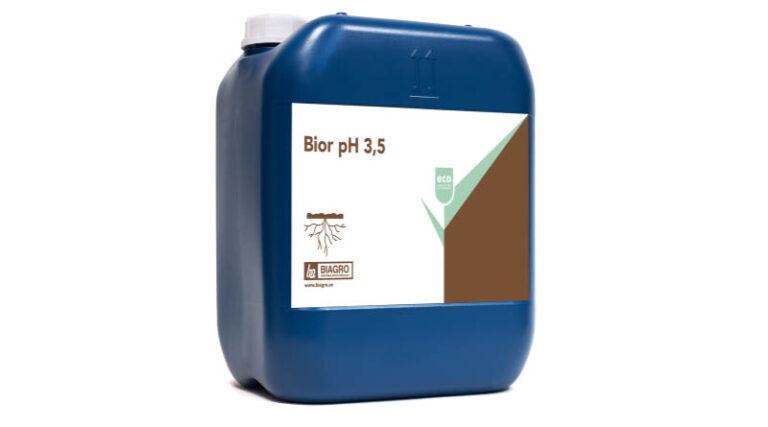
Bior pH 3,5 — Complexed Micronutrients Solution
02 August 2026, Valencia: Micronutrient deficiencies rarely show up in isolation. In most commercial growing operations, when one micronutrient runs short, others are often trending in the same direction, driven by shared underlying causes: high soil pH, poor organic matter content, excessive irrigation, or nutrient antagonisms that block uptake even when nutrients are technically present in the soil. Bior pH 3,5 was formulated to address this reality directly, offering growers a liquid, complexed blend of micronutrients designed to correct multiple deficiencies simultaneously while working within a low-pH formulation that improves compatibility and uptake efficiency.
The defining characteristic of Bior pH 3,5 is right there in the name: a formulation pH of 3.5. This acidic pH matters for two practical reasons. First, it helps stabilize the micronutrients in solution, reducing the risk of precipitation or antagonistic reactions between elements before the product ever reaches the plant. Second, when applied through fertigation, a lower pH input can help offset the alkalinity commonly found in irrigation water and calcareous soils — conditions that otherwise tie up micronutrients like iron, zinc, and manganese in insoluble forms that roots cannot absorb. In this sense, Bior pH 3,5 does double duty: it delivers nutrition and it actively works against one of the most common barriers to nutrient uptake in the field.
Just as important as the pH is the complexation strategy behind the formulation. The micronutrients in Bior pH 3,5 are bound with lignosulphonic acid, an organic complexing agent derived from natural sources. This complexation protects the nutrient ions from reacting prematurely with calcium, carbonates, and other soil components, keeping them soluble and available in the root zone for a longer window after application. For growers dealing with heavy or calcareous soils — where straight mineral salts often become locked up within days of application — this complexed delivery format offers a meaningful advantage in terms of how much of the applied nutrient actually ends up inside the plant rather than bound in the soil matrix.
Because Bior pH 3,5 addresses a spectrum of micronutrients rather than a single element, it’s particularly well suited as a preventive, broad-spectrum tool in nutrition programs. Many growers apply it at key phenological stages — early vegetative growth, prior to flowering, or during periods of rapid fruit development — when micronutrient demand spikes and any existing soil limitations are most likely to manifest as visible deficiency symptoms. Applying a complexed multi-micronutrient solution proactively, rather than waiting for chlorosis or other deficiency symptoms to appear, tends to produce more consistent results, since by the time visual symptoms show up, yield potential may already have been compromised.
This product fits within Biagro’s broader “edaphic regenerator” category, meaning it’s designed to be applied to the soil — typically via drip irrigation or fertigation systems — rather than as a foliar spray. The advantage of a soil-applied micronutrient program is that it works continuously as roots grow through the treated zone, rather than providing the one-time, surface-level correction typical of a foliar application. For crops with extensive root systems and long growing seasons, such as fruit trees, vines, and many vegetable crops grown under drip irrigation, this sustained availability translates into more even nutrient status across the crop cycle.
From a practical standpoint, liquid formulations like Bior pH 3,5 integrate easily into existing fertigation infrastructure. There’s no need for special mixing equipment or extended agitation, and the product is designed to be compatible with typical fertigation programs, allowing agronomists to build it into a broader nutrient plan alongside macronutrient fertilizers and other specialty inputs. This ease of integration is a significant factor for growers managing large operations where labor and application windows are limited.
Ultimately, the value proposition of Bior pH 3,5 lies in tackling two problems with one input: correcting existing or looming micronutrient shortfalls, and improving the underlying chemistry of the fertigation solution so that nutrients — both from this product and from complementary fertilizers applied alongside it — are more likely to remain available for uptake. For growers who have struggled with recurring, hard-to-pin-down deficiency symptoms across multiple micronutrients, particularly in alkaline or calcareous growing conditions, Bior pH 3,5 offers a practical, fertigation-ready way to regenerate soil nutrient availability from the ground up.
Also Read: Bayer Launches New Insecticide Trance for Cotton in India
Global Agriculture is an independent international media platform covering agri-business, policy, technology, and sustainability. For editorial collaborations, thought leadership, and strategic communications, write to pr@global-agriculture.com