Beyond The Baseline: First Lessons From Farming Systems Trials
19 July 2026, AU: New insights into the most profitable and sustainable crop rotations in high, medium and low-rainfall zones are being revealed in comprehensive farming systems research for the southern region.
In different regions, particular cropping rotations are more prevalent than others – and for good reason. Developed from years of experience, these practices have contributed to continually improving yields and productivity in the Australian grains sector.
Now these ‘baseline’ systems are providing an important reference point for research looking to understand how crops within a sequence interact to influence farm profitability and sustainability.
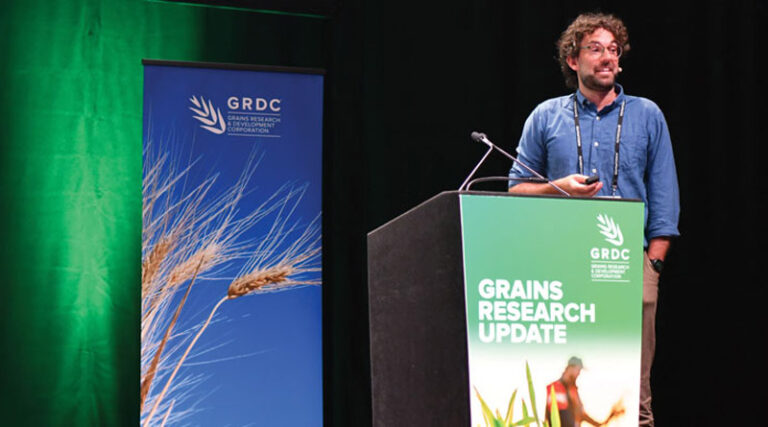
The GRDC investment is being led by Adelaide University’s Dr Matthew Knowling in collaboration with local advisers, agronomists and grower groups. It involves hundreds of treatments across 9 sites spanning a range of soil types in high, medium and low-rainfall zones in South Australia and Victoria.
Dr Knowling says farm productivity has increased over time, hand-in-hand with “great innovations in genetics and agronomy” improving the performance of individual crops.
“This project is about looking at how these innovations interact and play out over time,” he says.
The trials that began in 2023 are using the most common rotation in an area – as defined by local grower groups and advisers – as a ‘baseline’. This is compared to a range of alternative crop rotations as well as some new rotations.
Research aims
Responsive adviser-led systems, where rotations or inputs can be changed according to seasonal conditions, are also being assessed.
In the trials, within-season management factors including crop variety, plant density and sowing times are based on best practice, along with weed, disease and pest management. Nitrogen (N) rates are aligned with yield potential and determined by pre-sowing soil water and N-tests.
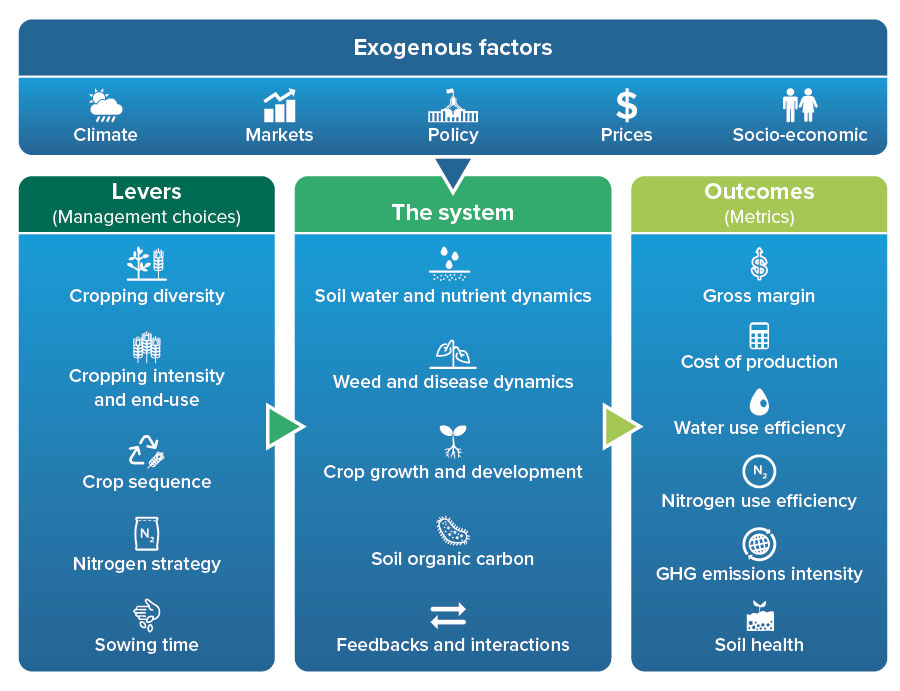
Dr Knowling says the research aims to identify a range strategies, or ‘levers’, that can improve particular objectives such as productivity, reliability or sustainability.
The objectives are measured through metrics including gross margins and economic water use efficiency, which look at how efficiently “every drop of rain” is turned into profit, he says.
We are evaluating a wide range of performance metrics, enabling trade-offs between profitability and sustainability or risk and reliability to be assessed. And while we are not looking for a silver bullet, we have, in the project’s first 3 years, identified a number of opportunities to improve profit without compromising reliability or increasing risk.
Results so far
Results from the first 3 years of the investment (2023 to 2025) – all below-average rainfall years – show some consistent trends across high (HRZ), medium (MRZ) and low-rainfall zones (LRZ).
These include:
- baseline systems generally performing well in terms of profit
- adaptive systems led by advisers often returning high gross margins
- similar profitability achievable using a range of systems
- clear legacy effects such as water and nitrogen benefits from particular crops.
Figure 1: Cropping systems at a glance
Baseline and beyond
The baseline system was the most profitable at the HRZ trial site at Streatham in south-west Victoria and equally the most profitable at Manangatang – a LRZ trial site in Victoria’s Northern Mallee.
At Streatham, the superior profitability of the baseline system (canola/wheat) was somewhat expected.
“This was no great surprise to growers in the region, but with questions from growers about how sustainable and resilient the system is, assessing alternative systems that reduce reliance on inputs such as urea becomes important,” Dr Knowling says.
The trials, run by Southern Farming Systems, tested an intercrop system where canola and field peas were grown together in rotation with wheat without any urea inputs. Compared with the baseline, it performed well, despite additional costs associated with post-harvest grain sorting and cleaning.
The intercrop yielded about 1 t/ha less canola but about 1.6 t/ha of field pea. So, we didn’t lose much revenue, but we saved on nitrogen because we weren’t feeding a monocrop canola.
The value of pulses in the rotation is also being explored in the Streatham trial. Faba beans are the preferred legume in the region.
While the baseline system of lentils/wheat/wheat at the Manangatang trial also returned high profit, gross margins were very similar (varying by only $30/ha per year on average) among a range of different systems. These included higher-frequency lentil rotations (lentils/lentils/wheat and lentils/wheat) through to continuous wheat.
Similar profit achieved by several systems across sites suggests that growers can have confidence that there is some flexibility in strategic decision-making, Dr Knowling says.
Opportunities for Improved profit
An alternative system outperformed the baseline in terms of profit at the MRZ trial site at Hart, in South Australia’s Mid North.
At this trial, managed by the Hart Field Site Group, the baseline system of lentils/wheat/barley performed well, achieving $340/ha per year on average.
But across the 3 dry years, the system that returned the highest average annual gross margin ($399/ha) was one that increased lentil frequency to every second year (lentils/wheat/lentils/barley).
The high-value pulse crop not only achieved profit in its own right, but it also added significant value (+$450/ha) to the subsequent barley crop. This was particularly evident in 2024, leaving more available water (+18 mm) and nitrogen (+49 kg N/ha) in the soil.
The extra residual water helped to increase barley yields by 1.1 t/ha on average, while fixing nitrogen reduced urea demand, providing a cost saving.
We saw that barley benefited from the deep stored water that lentil left behind when it really needed it in a very dry spring. That’s an interesting example of the mechanisms we are identifying that govern why systems perform differently.
Profit not always at odds with risk
Dr Knowling says it is encouraging that the first 3 years of trials found a similar return in profits across a range of systems.
This indicated there could be confidence in decision-making around rotations – a confidence strengthened by the finding that gross margins could be increased without extra risk.
For example, over 3 years of the Hart trial, the research found that higher gross margins brought by a greater frequency of lentils in the rotation were accompanied by less variability in year-to-year profits.
“That’s interesting and important because usually higher profits involve higher variability or risk, but this shows they’re not always mutually exclusive,” Dr Knowling says.
Way forward
Dr Knowling says the findings to date come with the caveat of being a product of 3 dry years. He hopes to test whether these findings hold under more favourable conditions.
Issues such as the potential trade-offs between profitability, reliability and sustainability measures such as greenhouse gas emissions are also being studied further, he says.
“The project is about trying to achieve multiple objectives, and while we’re talking a lot about profit, it’s also defining where trade-offs and synergies exist,” he says.
While the project is comparing different systems in terms of key metrics, such as profit, it is also generating new insights into the mechanisms driving such performance.
“Because we are measuring factors such as soil water, nitrogen and disease dynamics every year, we are understanding why systems are performing differently,” he says.
Dr Knowling says the researchers are seeking input from growers and advisers about systems they are keen to see tested.
If anyone has ideas about systems they think could push the boundaries further, we would love to hear them. And we are willing to try things that fail because that will help us learn where the barriers are.
Also Read: Crystal Crop Protection Launches Six New Products for Kharif 2026
Global Agriculture is an independent international media platform covering agri-business, policy, technology, and sustainability. For editorial collaborations, thought leadership, and strategic communications, write to pr@global-agriculture.com