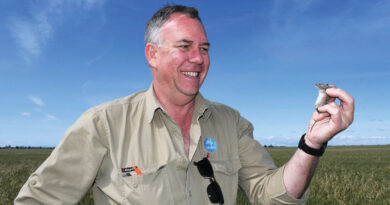
31 October 2026, AU: Understanding what drives the dramatic rise and fall of mouse populations remains a key challenge for researchers. CSIRO postdoctoral researcher Dr Ko-Huan Lee is investigating whether pathogens carried by wild mice may influence population dynamics and outbreak cycles.
A GRDC-supported CSIRO research team is taking a ‘know thy enemy’ approach to the grains industry’s mouse challenge, investigating the pathogens carried by rodents to better understand their role in mouse populations.
The work expands the industry’s multi- pronged approach to mouse management. Alongside research into mouse ecology, behaviour, surveillance and monitoring, CSIRO scientists are exploring whether disease may also influence the dramatic boom-and-bust cycles that characterise mouse populations.
The role of disease as a potential regulator of wild mouse populations has received little attention. The project has now delivered its first insights into this area of research.
Postdoctoral researcher Dr Ko-Huan Lee says the team’s analysis has confirmed that wild house mice carry a diverse array of bacteria, viruses and other microorganisms.
Using samples taken from mice captured during the 2021 mouse plague, researchers identified viruses associated with gastrointestinal diseases in humans, usually through faecal-oral transmission.
Dr Lee says the increase in bacteria and viruses in the higher populations is likely due to a higher risk of faecal-oral transmission at the higher mouse densities.
When mouse numbers are high, there is a greater likelihood of contamination of grain, fodder and water sources through mouse droppings.
Understanding population flux
The study included samples from cropping regions in south-eastern Australia and Central West New South Wales during the 2021 plague, and from lower-density populations in the Riverina, Mallee, Wimmera and Adelaide Plains.
For now, while the project has delivered a comprehensive picture of the pathogens carried by mice in Australian cropping regions, it has not identified a single pathogen capable of transforming control efforts.
“Many viral pathogens identified in high mouse populations were also present in low populations, suggesting that some are present regardless of population numbers and are well established as viral lineages,” he says.
“There was very little difference between the different populations and the variants of the pathogens, which means that the viruses in wild mice are widespread and relatively stable.
“In Central West NSW, we did not find any pathogens that were related to the mouse population dynamics. Hence, disease was not likely to be a significant factor in driving the population crashes in this cropping region during the 2021 mouse plague.”
Dr Lee says more data is needed to determine whether pathogens could be used to predict fluctuations in mouse populations.
For now, population control is still best achieved through established methods such as baiting. Reducing background food sources such as spilled grain is also important.
Global Agriculture is an independent international media platform covering agri-business, policy, technology, and sustainability. For editorial collaborations, thought leadership, and strategic communications, write to pr@global-agriculture.com