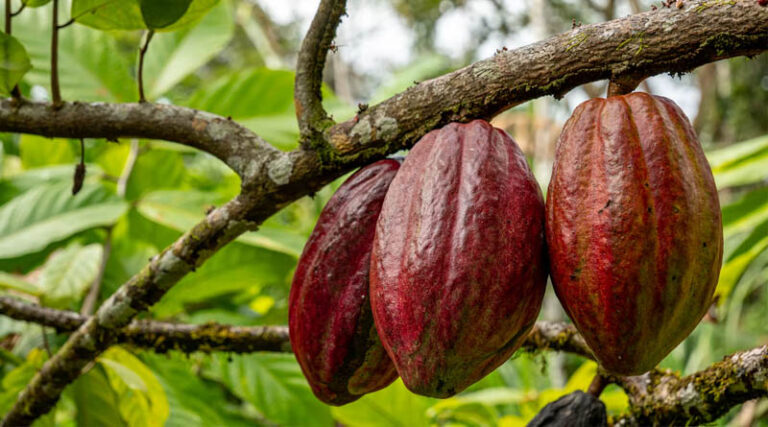
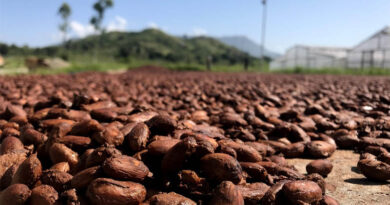
10 November 2026, Abidjan, CI: Ivory Coast’s cocoa mid-crop, the smaller of the country’s two annual harvests, is now expected to come in at between 300,000 and 350,000 tonnes for the April to September 2027 period, down from about 600,000 tonnes a year earlier, according to a survey of three pod counters and five exporters. The downgrade points to a tighter global cocoa supply heading into 2027, after erratic October rains failed to support flowering and pod development.
Ivory Coast is the world’s largest cocoa grower, and the mid-crop cut follows a weaker-than-expected main crop already under way. Yves Brahima Kone, director of the Coffee and Cocoa Council, the industry regulator, put the October 2026 to March 2027 main crop at around 1.2 million tonnes, down from 1.5 million tonnes a year earlier. Some pod counters had estimated the main crop as high as 1.3 million tonnes as recently as a month ago, before the extent of the rain shortfall became clear.
Full season 2026/27 output is now projected at 1.5 million to 1.6 million tonnes, down from roughly 1.7 million tonnes forecast in September and 25 to 30 percent below the approximately 2.15 million tonnes delivered to Ivorian ports last season. Port arrivals from October 1 to 25 ran to 122,453 tonnes, 43 percent below the same period a year earlier.
Weak rains, then intense heat
Growers and exporters blamed the shortfall on a strong El Niño pattern, among the strongest on record by some measures, which brought October rains too weak and irregular to support flowering and pod formation. A director at a European export company based in Abidjan said the rains came but were not strong enough, and the heat that followed was intense. Exporters are also watching the Harmattan, the dry wind that blows out of the Sahara from December into January, which threatens flowers and small pods on the trees.
Despite the production downgrade, Ivory Coast kept its fixed farmgate price for the 2026/27 main crop unchanged. Agriculture Minister Bruno Kone announced on September 1 that growers would be paid 1,200 CFA francs, around $2.12, per kilogram, matching the rate in place since March, when the government cut the price from a record 2,800 CFA francs per kilogram.
Ghana season also opens poorly
Next door in Ghana, the world’s second-largest producer, the season has started just as weakly. The Ghana Cocoa Board told growers in July that national output would fall by at least 16 percent this season, citing El Niño and excessive rainfall in May and June, after producing 771,000 tonnes in the prior season. The regulator did not respond to requests for an updated forecast or for an explanation of delays in fertiliser distribution, which normally reaches farmers between March and May but did not arrive until August this year.
Moses Djan Asiedu, administrator of the Ghana Cooperative Cocoa Farmers and Marketing Association, said farm visits across four cocoa-growing regions showed a mixed and unpredictable picture, with heavy rain in some areas causing flowers to drop while a lack of rain elsewhere left flowers to wither. He said whether the season recovers by March depends on rainfall in the coming months and on a Harmattan that is not too severe in January.
Joseph Agbeko, a cocoa farmer in one of the affected regions, said he had harvested five bags of cocoa so far this season, compared with 31 bags, or about two tonnes, at the same point a year earlier. He said rains had recently begun and he was hoping for a stronger harvest by March. The Ghana Meteorological Agency confirmed the presence of a strong El Niño and warned of possible prolonged dry spells that could further affect agricultural production.
Global Agriculture is an independent international media platform covering agri-business, policy, technology, and sustainability. For editorial collaborations, thought leadership, and strategic communications, write to pr@global-agriculture.com