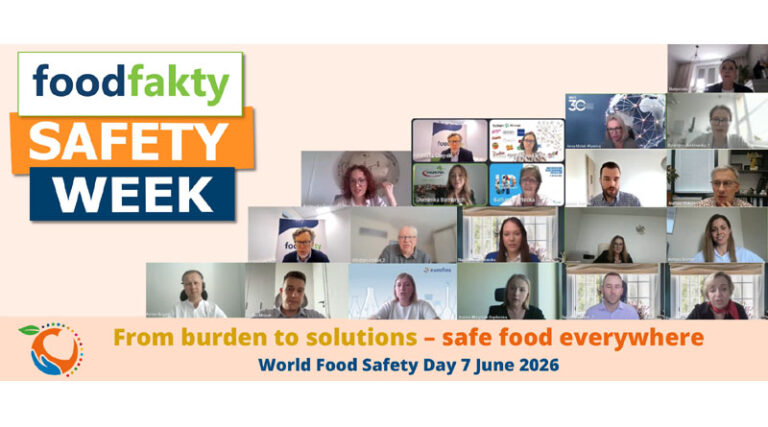
24 June 2026, US: To mark World Food Safety Day, the sixth FoodFakty Safety Week 2026 took place 8–12 June 2026. This year’s event, held under the theme “From Burden to Solutions – Safe Food Everywhere,” generated immense interest and emphasized the critical role that reliable scientific knowledge and efficient communication play in the modern food industry.
This edition attracted nearly 5500 participant registrations across five webinars. A vital component of each day consisted of engaging Question and Answer sessions, which allowed for a direct dialogue with the market, enabling attendees to ask experts detailed questions and apply theory to the daily practice of quality managers.
Overview of key thematic Aaeas and the course of FoodFakty Safety Week 2026
The programme for this year’s event was divided into five thematic blocks, each addressing real-world challenges currently faced by the food production and distribution sector. The speakers across all panels were recognized experts from the scientific community, state institutions, and leading companies that provide solutions for the food industry.
Monday: Organizational Resilience to Crises and Decision-Making in Uncertain Times. The week kicked off with a commemorative lecture touching upon the core theme of World Food Safety Day. In this block, experts discussed root cause analysis as a key tool for supporting safety culture and highlighted the role of artificial intelligence as a manager’s assistant in reporting and trend detection processes. The scientific portion was dedicated to the issue of building public trust through science. The day concluded with the announcement of a groundbreaking project – the “Polish Guide to Food Safety Culture,” presented by representatives of the Food Safety Culture Founding Committee.
Tuesday: New Consumer, New Expectations, New Risks. The second day focused on the areas of legislation, labelling, and the identification of new threats. An overview of the latest decisions within the Codex Alimentarius was presented, along with a detailed discussion on food claims and the issue of misinformation, using the dairy industry as an example. Experts also shed light on the dynamically evolving perspective of the plant-based protein market. Regarding allergens, the focus was placed on gluten detection methods, and the upcoming new era in PAL (precautionary allergen labelling) cross-contact warnings was outlined. The panel concluded by tackling the highly topical subject of the presence of microplastics in food.
Wednesday: Review of Global Food Safety Initiative (GFSI) Food Safety Systems. Sustainable Development Without Greenwashing. Wednesday’s discussions addressed strategic risk management and environmental, social and governance (ESG) standards. The most common non-conformities found in certification systems were analysed, and the significant legal and criminal risks associated with the phenomenon of greenwashing on product labels were pointed out. Furthermore, sustainable development was presented as a genuine competitive advantage, and the implications of implementing the Energy Efficiency Directive for the Polish food industry were outlined. The entire block was summarized with a comprehensive, system-oriented look at the topic from an academic perspective.
Thursday: Microbiological Hazards in the Era of Global Chains. Thursday brought a deep microbiological analysis. Experts presented rapid methods for the detection and control of pathogens, with a particular focus on Listeria monocytogenes, and discussed pathogen diagnostics in difficult food matrices. The limitations of classical microbiology in combating food spoilage were also highlighted. In turn, within the context of climate change, the risks associated with the impact of higher temperatures on the development of thermophilic bacteria were covered in detail.
Friday: Invisible Physico-Chemical Risks, Real Consequences. The final day was dedicated to hidden and future threats. The mechanisms through which FAO Foresight identifies emerging risks were explained, and hidden hazards in popular “free-from” products (free of specific ingredients) were pointed out. A detailed analysis was conducted on the issue of pesticide residues, as well as the currently crucial topic of the presence and risk analysis of PFAS substances in food and packaging. The week closed with a presentation demonstrating the practical use of data from the RASFF system for rapid adjustment and optimization of hazard monitoring in enterprises.
Strategic Programme Point: Food Safety Culture
A highlight of this year’s event was the presentation of the objectives of the latest project from Foodfakty – the “Polish Guide to Food Safety Culture”. The full release of this study and its broad discussion will be presented this November during the upcoming, in-person FoodFakty Summit in Łódź.
A note from the FoodFakty organizers: Acknowledgments to Partners and Participants
The success of an event of this scale and prestige would not have been possible without the commitment of a wide circle of specialists. We would like to express our sincere thanks to all substantive and technological Partners. However, the greatest thanks go to the participants themselves – your presence, counting in the thousands, and your active questioning stand as the best proof of the value of organizing this series.
Global Agriculture is an independent international media platform covering agri-business, policy, technology, and sustainability. For editorial collaborations, thought leadership, and strategic communications, write to pr@global-agriculture.com