MacEwan University Pairs Cheap Soil Test With VR Training for Global Farmers
21 September 2026, Alberta, Canada: Researchers at MacEwan University in Edmonton, Alberta, have built a virtual reality training platform to help farmers and field technicians around the world learn to use a low cost soil testing device the same team developed earlier, a step aimed at making precision agriculture practical in places where hands on training is hard to deliver.
The underlying device, Agrilo, was first introduced by the same researchers in 2025. It is a colorimetric soil test, meaning it measures nutrient levels based on how strongly a chemical reagent changes color when mixed with a soil sample, a method chemists have used for decades that Agrilo turns into a self contained, low cost field kit. A farmer mixes a small soil sample with a pre-filled solution, applies droplets to a paper or vinyl sensor strip, and photographs the result with a smartphone. An accompanying app analyzes the color pattern and reports levels of nitrate, phosphate, potassium, pH, sulphur, magnesium, manganese, calcium, boron, iron, organic matter and cation exchange capacity, a measure of how well soil can hold and supply nutrients to plant roots. Each sensor costs about $10, and results come back in minutes rather than the days typically needed to send a sample to a laboratory, at a fraction of the cost, which the researchers say often runs into hundreds of dollars per test at commercial soil labs. The developers say Agrilo’s readings have been validated against results from conventional laboratory testing.
Training at Scale Without Travel
The new work addresses a different problem: getting large numbers of farmers and extension staff to use the seven step testing protocol correctly and consistently, across regions with different literacy levels, languages and farming conditions. Agrilo VR runs on Meta Quest virtual reality headsets and walks trainees step by step through soil preparation, reagent mixing, timing and color reading, using a custom simulation that shows how the liquid mixing and color changes would look on a real workbench. The platform also collects cloud based usage data, meaning it automatically logs, with users’ consent, where trainees pause, repeat steps or ask for help, so the development team can see which parts of the protocol are causing confusion and refine the instructions accordingly.
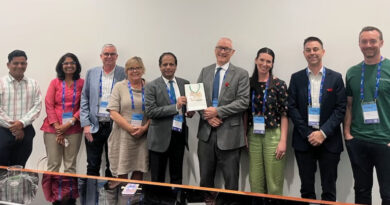
The project is led by Mohammed Elmorsy, an associate professor of computer science, and Samuel Mugo, a professor of chemistry, both at MacEwan University. The pair are also co-founders of PimaSens Inc, the university spinoff company commercializing Agrilo, a financial interest they have disclosed publicly. A partner researcher, Abel Mendez Porras at the San Carlos campus of Tecnologico de Costa Rica, is involved in testing the platform outside Canada. Funding came from Mitacs Global Link, the Riipen work integrated learning platform, and Alberta Innovates Summer Research Studentships.
Rather than a single pilot site, the team deliberately tested Agrilo VR across four very different locations: Medicine Hat in Alberta, Canada, KwaZulu-Natal province in South Africa, San Carlos in Costa Rica, and Nairobi in Kenya. Spreading the trial across these regions was meant to check whether one training module could work for users with different native languages, education levels, and access to reliable internet or hardware, rather than only for well resourced Canadian users. One of the researchers noted that the same training experience can now be delivered in multiple countries at once, without anyone needing to travel to run in person workshops.
No formal accuracy or completion rate statistics from the VR trial itself were published alongside this announcement, so it should be read as a report on a new training tool and its early multi-country deployment rather than a controlled study with statistical results. The underlying Agrilo device’s nutrient readings, by contrast, have already been checked against laboratory results in earlier published work by the same team.
Also Read: CropLife India Flags Narrowing Crop Protection Options for Farmers
Global Agriculture is an independent international media platform covering agri-business, policy, technology, and sustainability. For editorial collaborations, thought leadership, and strategic communications, write to pr@global-agriculture.com