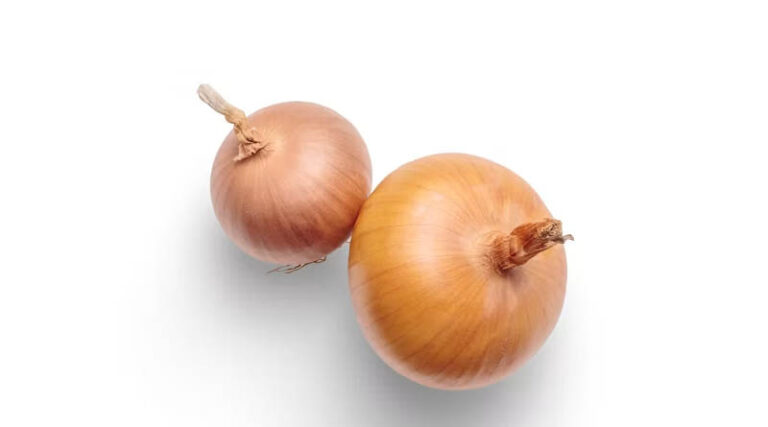
21 September 2026, Japan: Scientists at Chiba University in Japan, working with food manufacturer House Foods Group, have used CRISPR gene editing to knock down the gene responsible for making onions sting the eyes when they are cut. The work was posted as a preprint on bioRxiv on July 21, 2026, and a peer reviewed version has since appeared in the journal Frontiers in Plant Science, covered by the agricultural biotechnology tracker ISAAA’s Crop Biotech Update on September 16, 2026. It is an early stage proof of concept rather than a finished commercial variety, but it demonstrates that gene editing can directly target the specific enzyme behind onion tears.
The gene in question codes for an enzyme called lachrymatory factor synthase, or LFS. When an onion is cut, damaged cells release compounds that LFS converts into a volatile gas that irritates the eyes and triggers tears. Researchers have tried to reduce this effect for decades. In the 2000s, a New Zealand and Japanese team used a gene silencing technique to lower LFS activity in onions, a result published in Nature Biotechnology in 2008, but that approach never led to a commercial low tear onion variety. The new Chiba University and House Foods project instead uses CRISPR-Cas9, a gene editing tool that works like precise molecular scissors, cutting DNA at an exact location chosen by researchers, to directly disable the LFS gene rather than just muting its activity.
How the Editing Was Done
The team, whose authors include Shoya Tamaru and Takahiro Kamoi of House Foods and Tomoko Igawa of Chiba University, worked with onion calli, clumps of undifferentiated plant tissue grown in laboratory culture that can later be coaxed into regenerating whole plants. They used a common plant engineering method, Agrobacterium-mediated transformation, in which a soil bacterium is used to ferry new genetic material, in this case the CRISPR-Cas9 editing machinery, into plant cells. Seven different guide RNAs, short genetic sequences that direct the Cas9 enzyme to a specific site in the genome, were designed to target regions near the start of the LFS gene or its active site.
Out of 483 transgenic callus lines screened, 101 carried detectable mutations in the LFS gene. From these, the team regenerated 71 plants, examined 30 in detail, and confirmed 19 as true mutants using next generation sequencing, a DNA reading technology that can detect even small genetic changes with high accuracy. Five lines showed a mutation frequency above 50 percent, meaning more than half of the gene copies in those plants carried an edit. In leaf tissue, LFS enzyme activity fell to less than 40 percent of unedited control plants across all four mutant lines tested, and a similar drop showed up in bulb tissue, with more heavily mutated lines showing bigger reductions.
The results were not without problems. Many of the edited plants showed severe growth abnormalities, including stunted bulbs no more than four centimeters across, unusual root and leaf development, and excessively bushy growth. None of the edited plants produced seed, and several died after being moved from tissue culture into soil. The researchers attribute these issues mainly to somaclonal variation, unwanted genetic and chemical changes that can build up in plant cells kept in laboratory culture for long periods, rather than to unintended CRISPR edits elsewhere in the genome. That distinction matters because it suggests the growth problems could potentially be avoided with a shorter culture period or a different editing pipeline, rather than being an inherent side effect of removing the LFS gene itself.
Because the current edited lines cannot set seed, turning this result into a usable onion variety will require redoing the editing with methods that shorten tissue culture time, or breeding the trait into different onion backgrounds using more conventional plant breeding once a fertile edited line is available. House Foods’ involvement suggests commercial interest in a lower tear onion for both home cooks and food processing operations, where onion cutting is a significant source of worker discomfort, but the company has not announced a variety release timeline.
India is the world’s second largest onion producer and a major exporter, and Indian food processors dehydrate and process large volumes of onion into paste, flakes and ready to use products, work that exposes plant staff to the same eye irritating compound targeted in this study. A workable low tear onion variety could eventually improve working conditions in processing plants and open new consumer positioning in fresh markets, but the regulatory path for CRISPR edited crops differs by country, with some regulators treating edits that introduce no foreign DNA differently from conventional genetically modified crops, and market acceptance of gene edited vegetables remains largely untested. Seed companies and processors with an interest in onion should treat this as an early academic signal worth monitoring rather than a near term product to plan around.
Global Agriculture is an independent international media platform covering agri-business, policy, technology, and sustainability. For editorial collaborations, thought leadership, and strategic communications, write to pr@global-agriculture.com