CAC49 / Side Event Showcases Leadership And Advocacy For Sustainable Food Safety
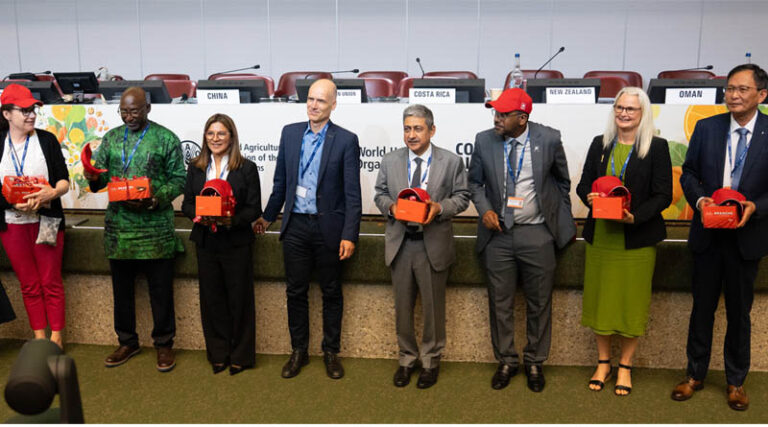
26 August 2026, US: At the 49th meeting of the Codex Alimentarius Commission (CAC49) in Geneva, Switzerland, a side event was organized, titled “Showcasing efforts to ensure sustainable food safety leadership and advocacy”. The event was sponsored by the Government of Switzerland and chaired by former CAC Chairperson Awilo Ochieng Pernet. Experts from China, Costa Rica, the European Union, The Gambia, India, New Zealand and the Sultanate of Oman shared approaches to leadership, collaboration, education, science-based decision-making and regional engagement.
Zhou Peng, President of the Shenzhen Institute of Standards and Technology (SIST), stressed the importance of Codex guidance and of integrating environmental and social governance into sustainable food safety. He highlighted ISO/PWI 37317 as a potential framework for implementation across food supply chains. SIST’s initiatives include the Youth Food Education Project, which has reached more than 800 000 students, a science popularisation and education centre with more than 320 000 visitors, and the Shenzhen Food Safety Forum, which has attracted more than 7 million participants from 19 countries and 22 international organizations since 2016.
Amanda Lasso Cruz of Costa Rica emphasized that a strong food safety culture requires sustained collaboration among public institutions, academia, local governments, the National Centre for Food Supply and Distribution and the private sector. Following Costa Rica’s 2016 proposal for a World Food Safety Day, a national strategy supported awareness campaigns and education. Innovative communication included food safety messages on National Lottery and Chance tickets, while supermarket chain Auto Mercado embedded training and awareness in its corporate culture. Awilo Ochieng Pernet recognized Costa Rica’s leadership in the international process that culminated in the unanimous adoption of UN General Assembly Resolution 73/250, declaring 7 June World Food Safety Day.
Judit Krommer of the European Commission highlighted political, policy and institutional leadership in the European Union. Codex standards and guidelines provide important international and regional references. The EU framework includes General Food Law and the Hygiene Package, supported by risk assessment from the European Food Safety Authority (EFSA) and enforcement by Member States. Food and feed operators have primary responsibility for compliance, traceability and withdrawal of unsafe products.
Representing The Gambia, Mamodou Bah, coordinator of the FAO/WHO Coordinating Committee for Africa (CCAFRICA) presented CCAFRICA’s work to build a resilient food safety culture under “Safe Food. Healthy People. Prosperous Africa.” He identified four pillars: leadership, science, partnerships and education. Regional collaboration, stronger national Codex structures, data-driven decisions and effective implementation of Codex standards are central to responding to population growth, urbanisation, climate change, expanding markets and the African Continental Free Trade Area.
Rajit Punhani of India presented the Global Food Regulators Summit, established by the Food Safety and Standards Authority of India (FSSAI) in 2023. Its 2025 edition brought together more than 3500 delegates from 59 countries. The summit promotes regulatory cooperation, knowledge exchange and innovation, covering harmonisation, sustainable food systems, digital surveillance and public-private engagement. FSSAI’s digital tools include the SanGRAH Handbook, covering regulatory authorities in 75 countries, and Food-O-Copoeia. The 2026 summit will take place in New Delhi in October.
Jenny Bishop introduced New Zealand’s food safety regulatory model, in which the regulator, recognized service providers and industry operators have complementary responsibilities. Governance guidance helps boards manage food safety risks and build organizational capability and culture. New Zealand Food Safety also provides training, communication materials and tools for operators and supports professional development among food verifiers.
Representing the Sultanate of Oman, Waleed Khafan Al Maamari, coordinator of the FAO/WHO Coordinating Committee for the Near East (CCNE), presented the CCNE Regional Work Plan 2026–2027, aligned with the Codex Strategic Plan 2026–2031. The plan aims to strengthen coordinated, science-based participation of Near East countries through regional priorities, data sharing, capacity development, expert working groups, training and coordination before priority Codex committees. It also promotes alignment of national standards with Codex texts, One Health approaches and stronger engagement with industry, academia, civil society and regional organizations.
Across the presentations, speakers consistently emphasized that food safety is a shared responsibility extending beyond regulation. Effective systems require informed consumers, capable regulators, engaged businesses, academic and scientific expertise, and mechanisms for regional and international cooperation. The examples also showed the value of translating standards into practical tools: education programmes, public campaigns, governance guidance, digital platforms, training, regional coordination and opportunities for regulators to exchange experience. These approaches support stronger trust, more consistent implementation and greater resilience while ensuring that food safety remains connected to public health, food security, trade, economic development and consumer confidence.
Overall, the side event demonstrated that sustainable food safety leadership depends on political commitment, science, education, partnerships and effective implementation, with national and regional initiatives reinforcing Codex’s international role.
Also Read: Jefferies Maintains Buy Rating on UPL, Sees 14% EBITDA Growth in FY27
Global Agriculture is an independent international media platform covering agri-business, policy, technology, and sustainability. For editorial collaborations, thought leadership, and strategic communications, write to pr@global-agriculture.com