Carbosulfan Deserves a Verdict Based on Indian Evidence, Not Borrowed Alarm
Guest Author: Kapoor R., Senior Advisor – South Asia, NarraHarvest Advisors
07 September 2026, New Delhi: A recent article asked a fair question about carbosulfan: was it always this dangerous, or did we simply stop being willing to look away? The honest answer offered there was that it was a bit of both – the chemistry was never a secret, but the real-world evidence about its consequences kept accumulating long after the molecule was first approved. That is a reasonable way to think about any pesticide’s history. It is also, if applied consistently, an argument for extreme care before India bans carbosulfan on the strength of a trade listing and a handful of incidents from other continents (ignoring the FAO Guidelines for Legislation on the Control of Pesticides 1985), rather than on what three decades of Indian use actually show.
That distinction between evidence that has genuinely accumulated about a molecule’s behaviour in a given setting, and alarm imported wholesale from a different one is where this debate should be settled. India is now weeks away from finalising a complete ban on carbosulfan, triggered by the pesticide’s recent listing under the Rotterdam Convention’s Prior Informed Consent (PIC) procedure. Before that happens, the Ministry of Agriculture owes farmers, and the regulatory process itself, a decision built on data generated here, about use here, not on a chemistry lesson from the 1970s or a poisoning survey from West Africa, since this precedence setting decision will impact entire crop protection industry and farming community for all times to come.
The Design Was Never Hidden. Neither Was India’s Own Scrutiny of It.
It’s true, as has been pointed out, that carbosulfan was engineered deliberately as a “pro-insecticide” a molecule designed to convert into carbofuran once inside a target pest, combining carbofuran’s efficacy with a gentler acute toxicity profile in the applied product. That was not a secret defect uncovered decades later; it was the design brief, understood by regulators from the molecule’s first evaluations in the 1980s onward.
What is less widely appreciated is how thoroughly India’s own regulatory apparatus has re-examined that design choice since. Carbosulfan has been registered in India since November 1997. In the years since, Indian regulators have conducted not one but five distinct rounds of hazardous-pesticide review: the Anupam Verma Committee’s 2013-15 examination of 66 molecules restricted abroad, the Registration Committee’s resulting 2016 prohibition order, the Malhotra Committee’s 2017-18 re-examination of 27 pesticides, the Khurana Sub-Committee’s 2019-20 draft notification covering the same 27, and the Rajendran Committee’s 2022 review, which narrowed the list of candidates for a ban to just three. Carbosulfan was never included in any of them. That is not an accident of bureaucratic oversight repeated five times over a decade. It is what a consistent, India-specific risk assessment looks like when applied to this molecule, by the same institutional machinery that has banned a long list of other pesticides in the same period.
Then, on 30 July 2026, the Registration Committee did something harder to reconcile with an imminent ban: it approved a label expansion for Carbosulfan 25% EC, extending its registration to control root-knot nematode on cucumber and chilli a pest complex India has strikingly few chemical options against. Three weeks later, the same government proposed banning the molecule outright. The Expert Review Committee whose report underpins that ban – chaired by Dr. Debasisa Mohanty, and considered by the Registration Committee at its 473rd meeting in June 2026 – has not published the underlying data behind its recommendation. Either the Committee had a live safety concern about carbosulfan on 30 July and expanded its use anyway, or it did not, and something other than new toxicological evidence intervened in the following three weeks. Both readings are uncomfortable for a regulatory process that is supposed to run on evidence, and neither has yet been explained.
What the Sri Lanka Data Actually Shows – and What It Doesn’t
Any honest treatment of this issue has to engage with the strongest evidence on the other side, rather than skip past it, and the most serious data point circulating is Sri Lankan clinical research showing that patients poisoned by carbosulfan died at a rate of roughly 11 percent more than five times the fatality rate recorded for carbofuran poisoning, despite carbosulfan sitting in a nominally less hazardous WHO toxicity category. That finding is real, it comes from careful clinical toxicology, and it deserves to be taken seriously rather than argued away.
But it needs to be read for what it is: a study of intentional self-poisoning, in a country with one of the highest rates of pesticide suicide in the world, using concentrated product ingested in quantity by someone trying to end their life. That is an entirely different exposure scenario from a farmer or farmworker applying a labelled dose in the field under recommended conditions. Sri Lanka’s own, widely studied response to its pesticide-suicide crisis was not to ban every moderately toxic compound outright, but to identify and restrict the specific highly lethal products most implicated in fatal self-poisoning a targeted, evidence-driven intervention aimed at the actual point of harm. Conflating that finding with occupational and agronomic risk under Indian field conditions, where the relevant exposure pathway is entirely different, is exactly the kind of evidence-mismatch the original essay’s own argument warns against: judging a molecule’s risk in one context using data generated in a completely different one.
The same caution applies to the Rotterdam Convention listing that triggered this entire review. The West African notification behind that listing rested on a retrospective survey in Burkina Faso that documented 296 pesticide-poisoning cases in total of which exactly one was tentatively associated with a locally manufactured, multi-active formulation containing carbosulfan, with no causal relationship established and no exposure-to-outcome analysis of the kind the Convention’s own Annex II calls for. The European Union’s notification, for its part, arose from a 2008 administrative non-renewal under EU pesticide regulations, not from a fresh, India-relevant safety finding. Both are legitimate inputs into a global information-sharing system. Neither constitutes the kind of India-specific risk evidence that should drive a domestic prohibition, and neither is the reason India’s own review committees have found it registered for use across three decades.
Thirty Years, Thirty-Two Lakh Acres, and No Domestic Signal
Set against this is a domestic record that is, on its own terms, unusually clean. Carbosulfan currently protects an estimated 32 lakh acres of Indian cropland every year, across rice, cotton, chillies, cumin, brinjal and cucumber, at a cost farmers can afford. Over 30 years of use, industry records show no verified case of human toxicity traceable to labelled agricultural use, no confirmed environmental incident, no residue violation above permitted limits, and no rejection of Indian agricultural exports on account of carbosulfan residue. The molecule’s own toxicological dossier – WHO Toxicity Category II, non-mutagenic, non-carcinogenic, non-teratogenic, not an endocrine disruptor, with a soil and water half-life of just seven to ten days and no bioaccumulation potential does not match the “intrinsically highly hazardous” language used to justify the proposed ban. It is worth noting, too, that the specific hazard cited – conversion to carbofuran – is shared by other carbamates, such as benfuracarb, that remain freely registered and marketed in India today, which makes it difficult to argue that this particular hazard, by itself, is what has changed.
None of this is an argument that toxicology doesn’t matter, or that hazard classifications should be ignored. It is an argument that when a molecule has a three-decade domestic track record, has survived five successive rounds of dedicated Indian regulatory review without being flagged, and was approved for an expanded use weeks before a ban was proposed, the burden should sit with demonstrating what new, India-specific evidence has emerged not with assuming that an international trade listing settles the question.
The draft order also leans on the absence of a specific antidote to reverse carbosulfan’s toxic effects, which is accurate but easy to over-read as meaning the poisoning is unmanageable. It isn’t. Atropine – the actual treatment for this class of poisoning – is listed in India’s own National List of Essential Medicines and approved by the Drugs Controller General of India precisely for carbamate poisoning, with good outcomes when given promptly. What doesn’t exist is a drug that chemically reverses carbamate binding to the enzyme also true of every other carbamate currently registered in India, carbofuran and benfuracarb included. A treatment gap common to an entire, still-registered class is not evidence that one molecule in it is uniquely dangerous.
The Agronomic Case Nobody Disputes
Even sympathetic commentary on carbosulfan’s history has conceded the practical point that matters most to Indian agriculture: India works with a comparatively narrow basket of registered crop-protection molecules next to markets like the EU or the United States, and removing an effective tool without a ready replacement risks handing the advantage back to the pest, not forward to safety. That is precisely the situation carbosulfan’s removal would create. The Agro Chem Federation of India has separately made the same case publicly, calling for a science-based assessment centred on regulated, responsible use rather than an outright ban a position echoed by CropLife India and FICCI in their submission to the review committee in May.
The economic footprint behind that argument is not trivial. Carbosulfan sustains a domestic market estimated at ₹350-400 crore a year across technical-grade and formulated product sales. The ACFI estimates that Carbosulfan technical grade material sustains an estimated 30 to 50 downstream companies engaged in formulating, repacking and distributing the product, sitting within a national pesticide value chain of more than 65,000 entities a great many of them small and medium enterprises, distributors and retailers whose livelihoods are tied, in some part, to molecules exactly like this one.
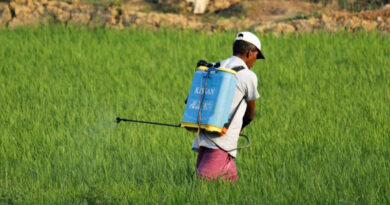
Gall midge in rice has become a serious and growing threat across southern India and the eastern coastal belt, and carbosulfan is, for many farmers, one of very few effective, affordable registered options against it. It also represents a genuinely different mode of action from many newer chemistries now in use, which matters for resistance management: narrowing the rotation of active ingredients available to farmers tends to accelerate resistance in exactly the pests a ban is meant to help control, not reduce the underlying problem. And the pending nematode-control use approved by the Registration Committee only weeks ago addresses a pest complex against which Indian farmers currently have very few chemical tools at all. An immediate ban would strand that option before it ever reaches the field, alongside the substantial inventory of technical-grade material and formulated product that industry has manufactured in good faith under a valid, currently subsisting registration.
What a Genuinely Evidence-Based Decision Would Look Like
The lesson from carbosulfan’s forty-year regulatory history is not that early approvals were reckless or that hazard classifications are meaningless. It is that good pesticide regulation is built by patiently accumulating real-world evidence about how a molecule behaves in the setting where it is actually used, and updating decisions as that evidence matures exactly the argument made in defence of re-examining carbosulfan’s global status in the first place. Applied honestly, that same standard argues for keeping the Indian decision anchored to Indian evidence: three decades of field use, five rounds of expert review that found nothing to flag, a regulatory approval granted three weeks before the ban was proposed, and a toxicological and environmental-fate profile that does not match the language used to justify prohibition.
If new information genuinely warrants tighter controls narrower approved uses, buffer zones near water bodies and pollinator habitat, restricted formulations, dealer-only sale, enhanced applicator training, a defined post-market surveillance period – those are reasonable, proportionate responses, and precedents for exactly this kind of risk-mitigation approach already exist in India’s own regulatory history. What does not follow from the evidence on the table is an immediate, total ban, imposed without disclosing the underlying data, without a hearing, and without reconciling a ban notification with the same Committee’s own decision, three weeks earlier, to expand the product’s approved use.
Indian farmers, and the regulatory process itself, deserve a decision that can explain that three-week gap. Until it can, the case for prohibition remains an imported conclusion in search of domestic evidence not the other way around.
Also Read: Bayer Advances Plan to Launch 10 Blockbuster Products Over the Next 10 Years
Global Agriculture is an independent international media platform covering agri-business, policy, technology, and sustainability. For editorial collaborations, thought leadership, and strategic communications, write to pr@global-agriculture.com